
📘 AWARENESS GUIDE · EXPLAINER
Master ID Betting Explained: Meaning, Risks and Legal Status in India
You may have seen the term “Master ID” in cricket betting ads and group chats. This guide explains in plain language what it usually means, how master and sub-account structures are described, what the risks are and where Indian law currently stands. It is an awareness guide, not an offer, and it does not explain how to obtain any betting account.
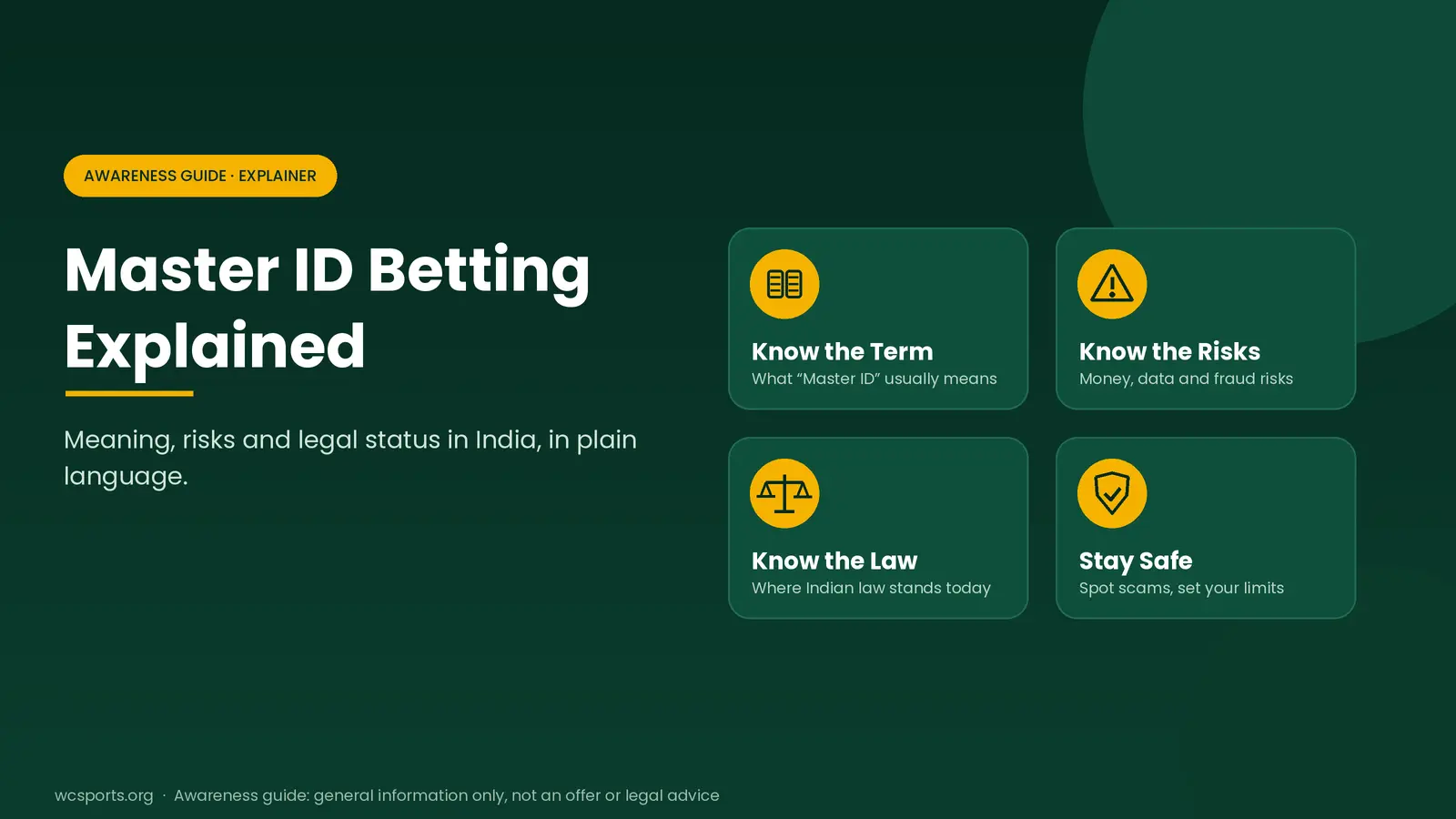
Know the Term
Understand what “Master ID” usually means
Know the Risks
Money, data and fraud risks explained
Know the Law
Where Indian law stands today
Stay Safe
Spot scams and set your limits
What Is a Master ID in Online Betting?
In Online Cricket Betting circles, a Master ID usually refers to a higher-level account on an exchange-style platform. Unlike an ordinary user account, it is described as one that can create and manage other accounts beneath it, such as sub-accounts or agent accounts, and track their activity.
The term is not used consistently. Some sellers use “Master ID” loosely for any betting account, while others mean a business-style role with client management and commission. Because the meaning shifts, always ask what exactly is being described before you believe any claim. For general safety guidance, read our Responsible Gaming page.
A Master ID Is Usually Described As
- A higher-level account above ordinary user accounts
- A way to create and manage lower-level accounts
- A role linked to client limits and point balances
- A role often described as earning a share or commission
Why Understanding the Master ID Term Matters
Clear information is the best protection against confusing and misleading offers.
Avoid Confusion
The same words are used for very different things, so clear definitions help you read claims carefully.
Recognise Big Promises
Offers of easy commission or guaranteed returns are a common hook, and they deserve extra doubt.
Understand the Risk
Managing other people’s balances means handling their money, which carries serious responsibility.
Protect Your Data
Sharing ID proofs, passwords or OTPs with unknown agents can lead to misuse.
Know the Law
Rules can change, so understand the legal position before getting involved in anything.
How Master ID Structures Are Commonly Described
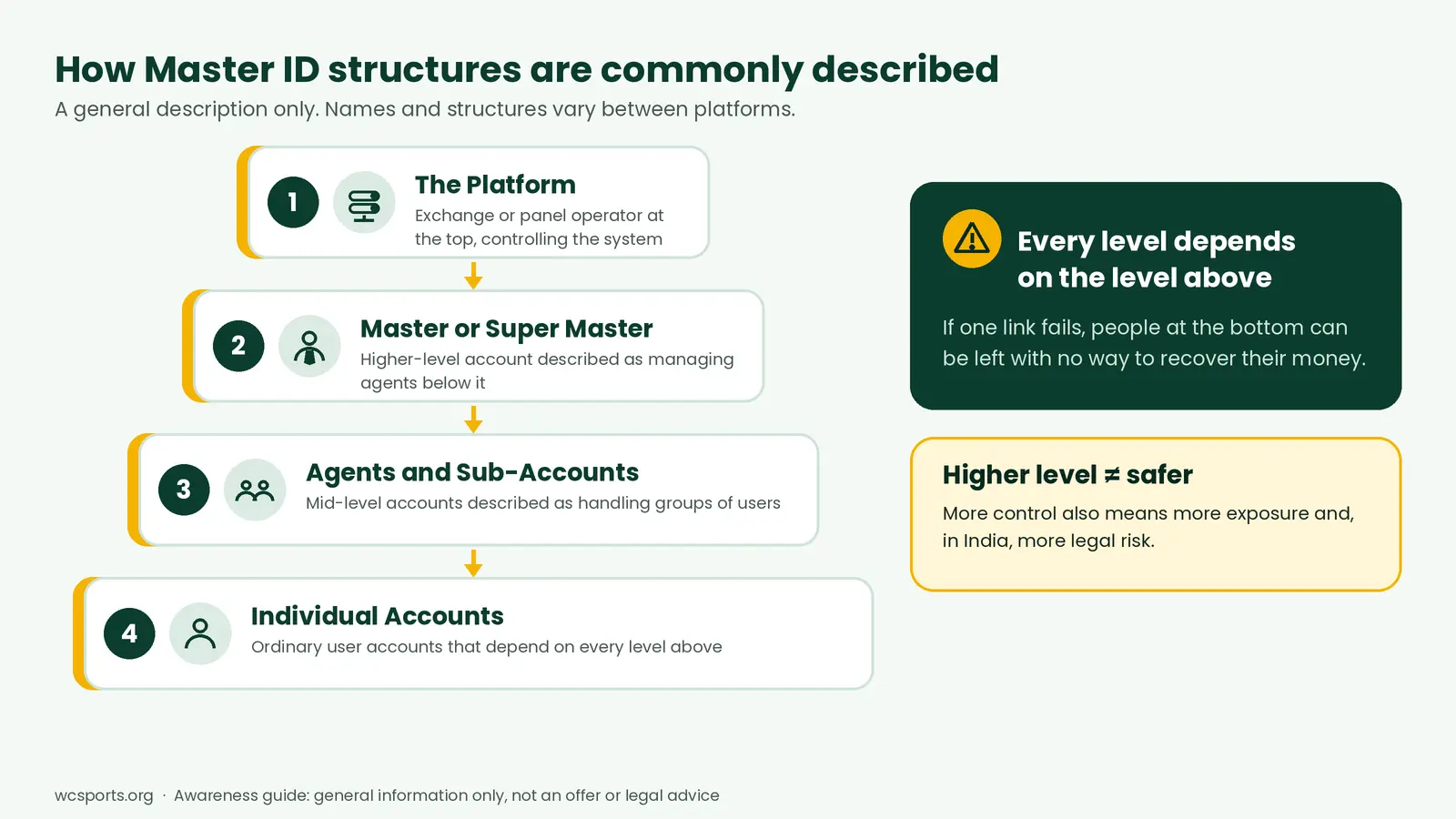
Level 1: The Platform
A betting exchange or panel operator is described as sitting at the top and controlling the system.
Level 2: Master or Super Master
A higher-level account is described as managing agents or sub-accounts below it.
Level 3: Agents and Sub-Accounts
Mid-level accounts are described as handling groups of users and their balances.
Level 4: Individual Accounts
Ordinary user accounts sit at the bottom and depend on every level above for payouts.
Every level in this chain depends on trust in the level above it. If one link fails, the people at the bottom can be left with no way to recover their money. Names and structures vary between platforms, so treat this as a general description, not a guide to joining any of them.
Master ID vs Regular ID: What Differs
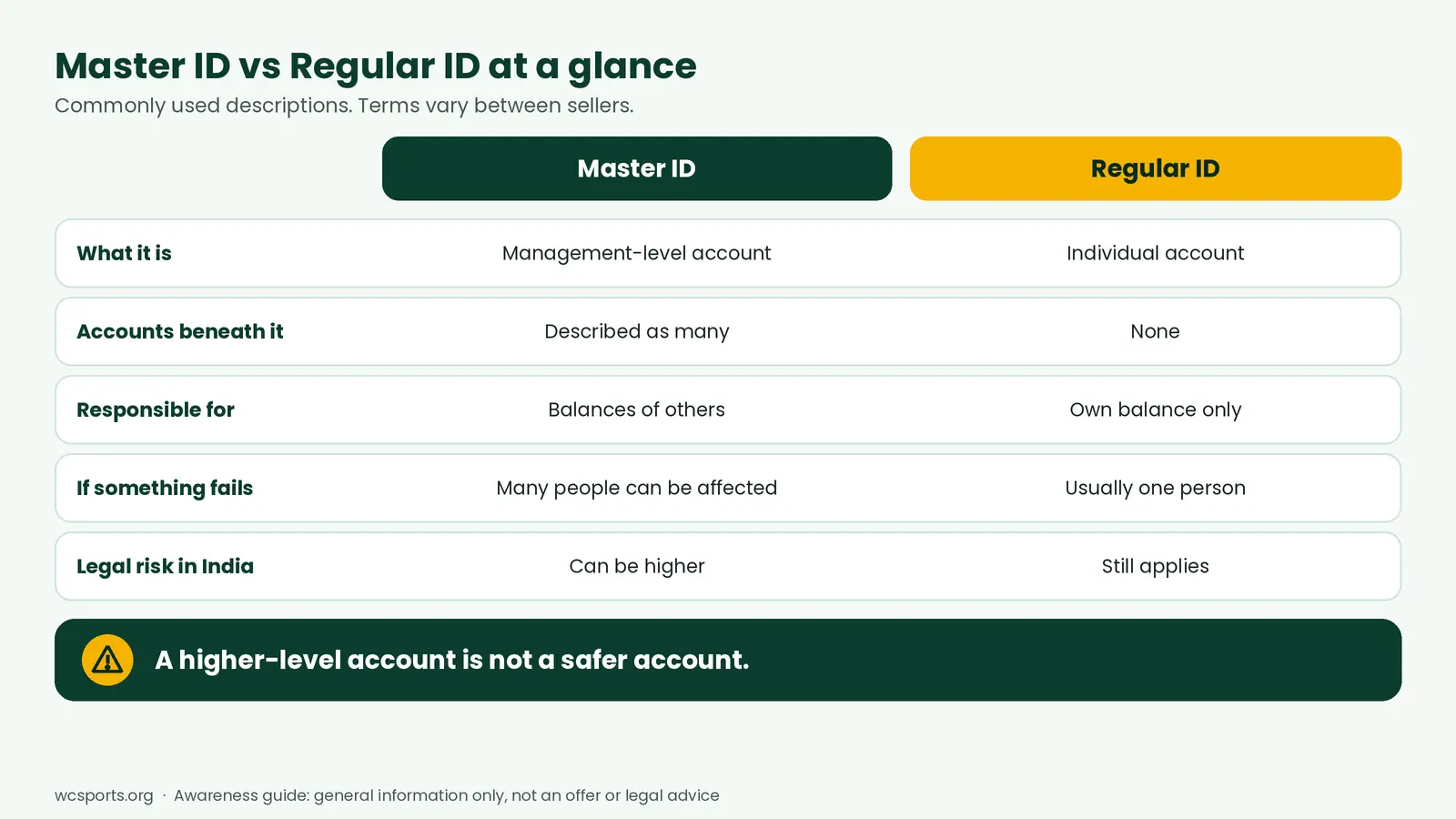
A regular ID is usually described as an individual account used by one person. A Master ID is described as a management-level account that can sit above many accounts. The second carries far more responsibility, because errors, disputes or fraud can affect everyone below it.
A higher-level account is not a safer account. More control also means more exposure, more paperwork and, in India, more legal risk. Before considering any such role, read our responsible gaming guidance and take qualified legal advice.
Risks of the Master ID Model
Keep your expectations realistic:
- Commission claims often depend on other people losing money.
- You can be held responsible for the balances of people below you.
- Payout delays or disputes can affect many users at once.
- There is usually no formal customer protection or grievance route.
- Legal exposure can apply to the person running the account.
Warning Signs of a Master ID Scam
Be careful if an offer:
- Asks for a fee to “unlock” or “activate” a Master ID
- Asks for your password, OTP or ID documents
- Comes from an unknown person who messaged you first
- Promises guaranteed profit or a fixed monthly income
- Pushes you to decide or pay quickly
Questions to Ask Before Trusting Any Claim
Slow down and check:
- Who runs the platform, and can that be verified?
- Is the offer legal where you live?
- What happens to your money if the person above you disappears?
- Is any promise in writing, or only said in chat?
- Does the offer pressure you to move fast?
Common Misconceptions
Many problems start from a few wrong beliefs:
- “A Master ID guarantees steady income.”
- “A higher level means lower risk.”
- “Screenshots of profits prove anything.”
- “Everyone in the group chat is trustworthy.”
- “Because it is online, the law does not apply.”
Legal Status in India and Responsible Play
India’s Promotion and Regulation of Online Gaming Act, 2025 prohibits online money games, which includes betting and wagering. The Online Gaming Rules were notified on 22 April 2026 and have been in force since 1 May 2026. Constitutional challenges to the Act have been before the Supreme Court since January 2026. The Act is generally summarised as covering offering, promoting and facilitating such games, not only running them. Because the position can change, check current official sources and take qualified legal advice.
This page is for general information only. It is not legal advice, and it is not an offer or invitation to place bets or to take up any account or role. Online platforms are for adults aged 18 and above, and nobody should spend money they cannot afford to lose. If gambling is causing you stress, speak to someone you trust or a qualified professional.
Frequently Asked Questions
What is a Master ID in betting?
It is a term used for a higher-level account that is described as managing other accounts beneath it. The meaning varies between sellers, so always ask what is actually being described.
Is a Master ID the same as a Cricket ID?
Not necessarily. A cricket ID is usually an ordinary user account, while a Master ID is described as a management-level account. Some sellers use the two terms loosely.
Is Master ID betting legal in India?
The Promotion and Regulation of Online Gaming Act, 2025 prohibits online money games, including betting and wagering, and the related rules have been in force since 1 May 2026. Challenges are before the Supreme Court, so check current sources and take legal advice.
Can a Master ID make guaranteed money?
No. Any claim of guaranteed or fixed income is a major red flag. Outcomes can never be guaranteed, and such a role carries financial and legal risk.
How can I spot a Master ID scam?
Watch for upfront fees, requests for passwords or OTPs, unknown agents who contact you first, guaranteed-profit promises and pressure to act quickly.
Does this page offer a Master ID?
No. This page is an awareness guide. It does not offer, sell or arrange any account, and it does not explain how to obtain one.
What is the difference between a Master ID and a regular ID?
A regular ID is an individual account. A Master ID is described as a management-level account sitting above many others, which brings more responsibility and more risk.
Is it safe to share documents or OTPs with a Master ID agent?
No. Never share passwords, OTPs or identity documents with anyone you cannot verify.
What if the person above me in the chain disappears?
In informal structures there is often no clear way to recover funds. This is one of the main reasons these arrangements are risky.
Do I need to be 18 or older?
Yes. Only adults aged 18 and above should use online platforms of this kind, and the law that applies to you always comes first.
Stay Informed and Play Safe
Read, compare and question every claim before you act. Clear information protects you from scams and costly mistakes.
