
📘 AWARENESS GUIDE · SPORTS EXPLAINER
Sports Betting ID: What It Means, Real Risks and Legal Status in India
Searching for a sports betting ID usually leads to ads, reseller posts and group chat offers. This guide explains in plain language what the term usually means across cricket, football, tennis and other sports, how sportsbook-style and exchange-style panels are described, what the risks are and where Indian law currently stands. It is an awareness guide, not an offer, and it does not explain how to obtain any betting account.
Know the Term
Understand what “sports betting ID” usually means
Know the Markets
Sportsbook and exchange panels in plain words
Know the Law
Where Indian law stands today
Stay Safe
Spot scams and set your limits
What Is a Sports Betting ID?
A sports betting ID usually refers to a username and password for an account on a sports betting website or panel. The account is described as the place where a person’s balance, bets and history are tracked across sports such as cricket, football, tennis and kabaddi. Such IDs are often described as being issued through agents or resellers on chat apps rather than through a normal sign-up.
The wording is not consistent. “Sports betting ID”, “betting ID”, “cricket ID” and “exchange ID” are often used for the same thing, and sometimes for different things. A sports betting ID is also not the same as a match ID, which only points to one specific game. Because the meaning shifts, always ask what exactly is being described before you believe any claim. For general safety guidance, read our Responsible Gaming page.
A Sports Betting ID Is Usually Described As
- A username and password for a sports betting panel
- A balance shown as “points” linked to that login
- Often issued through an agent or reseller, not the platform directly
- A way to view markets across sports and place stakes
Why Understanding a Sports Betting ID Matters
Search results for this term are full of promotional pages, so clear information is your best protection.
Cut Through the Noise
Many pages that rank for this term are promotions, so read every claim with care.
Recognise Big Promises
Huge bonuses, instant IDs and guaranteed returns are a common hook, and they deserve extra doubt.
Understand the Risk
Money staked on any sports result can be lost, and no result can ever be guaranteed.
Protect Your Data
Sharing ID proofs, passwords or OTPs with unknown agents can lead to misuse.
Know the Law
Rules can change, so understand the legal position before getting involved in anything.
How a Sports Betting ID Is Commonly Described to Work
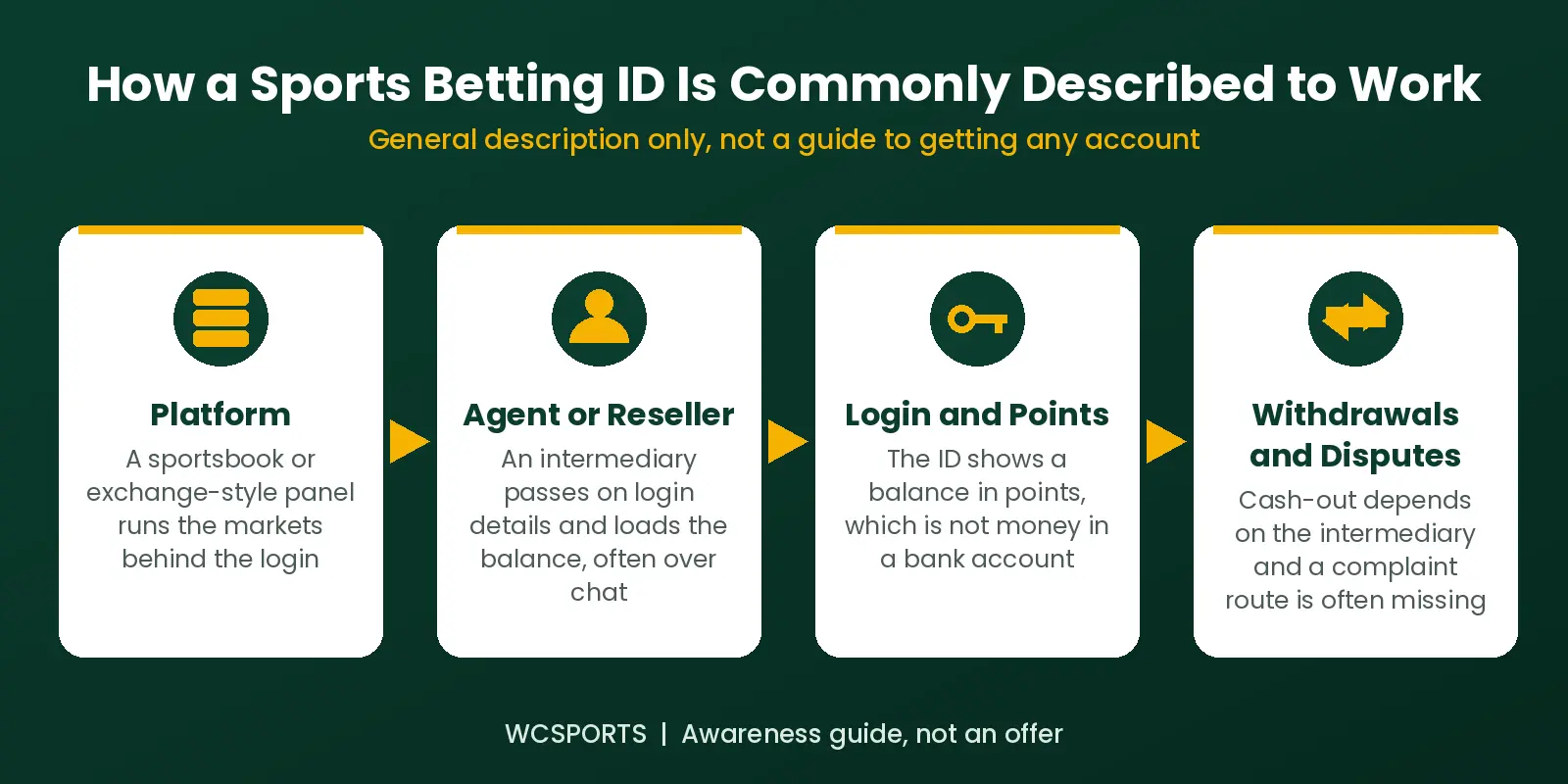
Stage 1: The Platform
A sportsbook or exchange-style panel is described as running the markets behind the login.
Stage 2: The Agent or Reseller
An intermediary is described as passing on login details and loading balances, often over chat.
Stage 3: The Login and Points
The ID shows a balance in points. That figure is not the same as money in a bank account.
Stage 4: Withdrawals and Disputes
Getting money out often depends on the intermediary, and a formal complaint route is often missing.
In a sportsbook-style panel, the operator is described as setting the odds. In an exchange-style panel, users are described as backing and laying outcomes against each other. In both cases, many arrangements run through chat apps and informal payments, so there is often no receipt, written contract or official complaint route. Names and processes vary, so treat this as a general description, not a guide to getting or using any account.
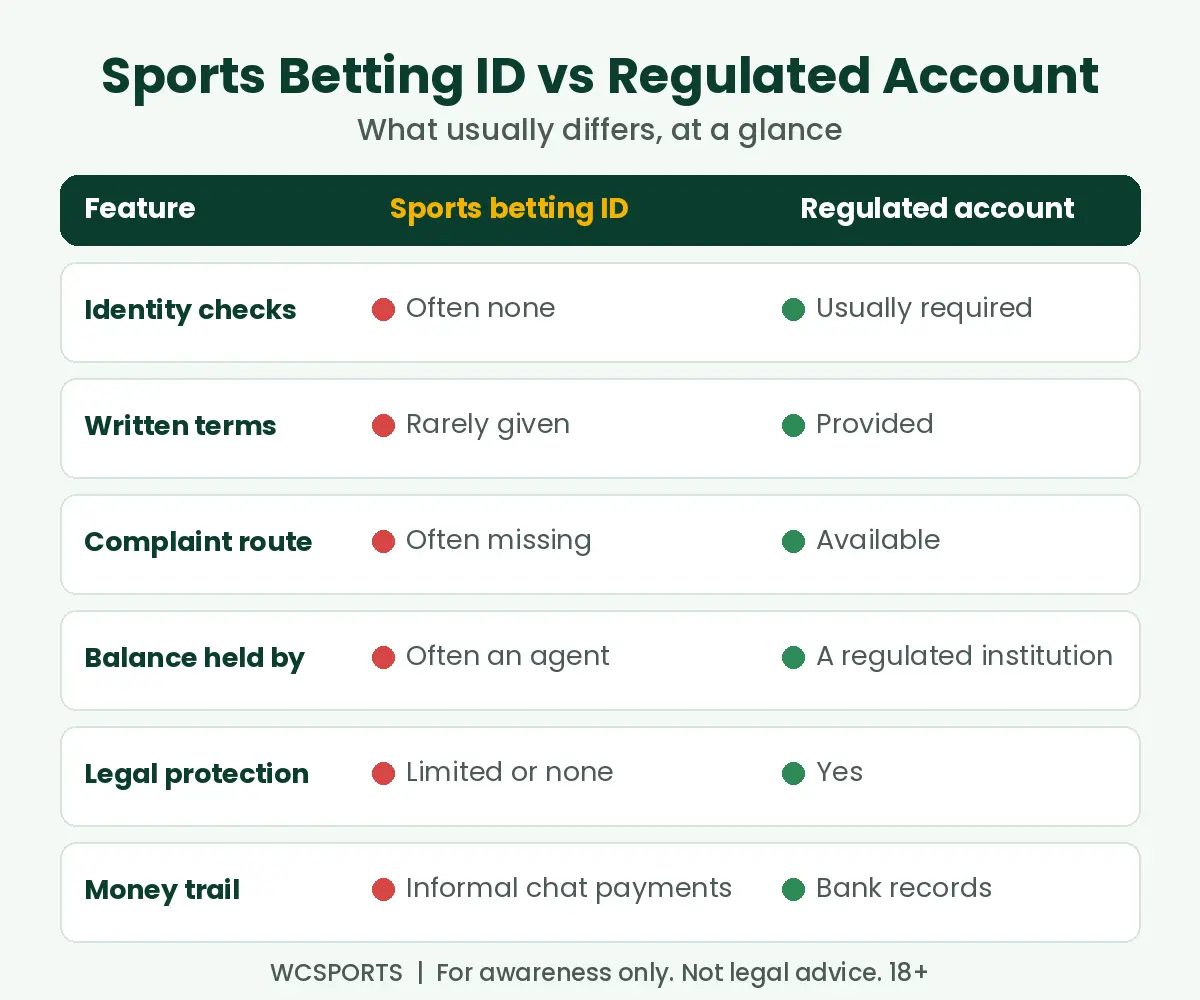
Sports Betting ID vs Regulated Account: What Differs
A bank or other regulated financial account usually comes with identity checks, written terms, a complaint process and legal protection. A sports betting ID obtained through an agent usually comes with few or none of these. The balance shown is described in “points”, and that figure is only as reliable as the people and systems behind it.
That is why a Online Cricket ID is not a safe place to keep money. Before considering any such account, take qualified legal advice, because in India the legal risk can apply to users as well as sellers.
Risks of Using a Sports Betting ID
Keep your expectations realistic:
- You can lose the money you stake, and no sports result can be guaranteed.
- Balances may sit with an agent rather than a regulated institution.
- Withdrawals can be delayed, limited or refused.
- Your login and payments can be misused if details are shared.
- Using or promoting such services can carry legal exposure in India, and linked payments can be blocked.
Warning Signs of a Fake Sports Betting ID
Be careful if an offer:
- Asks for a fee to “unlock” or “activate” an ID
- Asks for your password, OTP or ID documents
- Comes from an unknown person who messaged you first
- Promises guaranteed profit, fixed returns or “fixed matches”
- Offers an “instant” ID with no identity checks or written terms
Questions to Ask Before Trusting Any Offer
Slow down and check:
- Who runs the platform, and can that be verified?
- Is the offer legal where you live?
- What happens to your balance if the agent disappears?
- Is any promise in writing, or only said in chat?
- Are the odds, limits and withdrawal rules written down anywhere?
Common Misconceptions
Many problems start from a few wrong beliefs:
- “A sports betting ID guarantees profit.”
- “Knowing the sport well removes the risk.”
- “Screenshots of withdrawals prove anything.”
- “Anyone in a group chat can be trusted.”
- “Because it is online, the law does not apply.”
Legal Status in India and Responsible Play
India’s Promotion and Regulation of Online Gaming Act, 2025 prohibits online money games, which includes betting and wagering on sports. The Promotion and Regulation of Online Gaming Rules, 2026 were notified on 22 April 2026 and came into force on 1 May 2026, and they allow banks and payment intermediaries to be directed to block transactions linked to such games. Challenges to the Act and the Rules are pending before the Supreme Court. The Act is generally summarised as covering offering, promoting and facilitating such games, not only running them. Because the position can change, check current official sources and take qualified legal advice.
This page is for general information only. It is not legal advice, and it is not an offer or invitation to place bets or to take up any account. Online platforms are for adults aged 18 and above, and nobody should spend money they cannot afford to lose. If gambling is causing you stress, speak to someone you trust or a qualified professional.
Frequently Asked Questions
What is a sports betting ID?
It is a term for a username and password for an account on a sports betting platform, often described as being issued through an agent. The meaning varies between sellers, so always ask what is actually being described.
Is a sports betting ID the same as a cricket ID or a match ID?
Sellers often use “sports betting ID”, “cricket ID” and “exchange ID” loosely, but a match ID usually points to one specific game, not to an account. Check what is really meant.
Is sports betting legal in India?
The Promotion and Regulation of Online Gaming Act, 2025 prohibits online money games, including betting and wagering, and the 2026 Rules have been in force since 1 May 2026. Challenges are pending before the Supreme Court, so check current sources and take legal advice.
Can a sports betting ID guarantee profit?
No. Any claim of guaranteed or fixed returns is a major red flag. Sports results can never be guaranteed, and money staked can be lost.
How can I spot a fake sports betting ID offer?
Watch for upfront fees, requests for passwords or OTPs, unknown agents who contact you first, guaranteed-profit promises and “instant” IDs with no checks.
Does this page offer a sports betting ID?
No. This page is an awareness guide. It does not offer, sell or arrange any account, and it does not explain how to obtain one.
What is the difference between a sportsbook and an exchange?
A sportsbook is described as an operator that sets the odds. An exchange is described as a place where users back and lay outcomes against each other. Both carry risk, and neither removes it.
Which sports does a sports betting ID usually cover?
Sellers commonly mention cricket, football, tennis, kabaddi and basketball. Coverage claims are often unverified, so treat them with caution.
Is it safe to share documents or OTPs with an agent?
No. Never share passwords, OTPs or identity documents with anyone you cannot verify.
What if the agent who gave me an ID disappears?
In informal arrangements there is often no clear way to recover a balance. This is one of the main reasons they are risky.
Do I need to be 18 or older?
Yes. Only adults aged 18 and above should use online platforms of this kind, and the law that applies to you always comes first.
Stay Informed and Play Safe
Read, compare and question every claim before you act. Clear information protects you from scams and costly mistakes.
